What Is Tower Rush
Tower Rush is a fast game developed by Galaxsys, sitting in the crash game category by format but diverging from it in meaningful ways. The setting is a construction site: floor segments fall from above and stack onto your tower one by one. Each successfully placed floor adds to your multiplier. You decide when to stop and collect — or you keep building until the tower collapses and the round ends with your stake lost.
The 100× multiplier ceiling keeps expectations realistic. Unlike some crash games that advertise theoretically unlimited multipliers, Tower Rush sets a defined upper limit — which also means the maximum payout of $10,000 is genuinely attainable rather than a theoretical figure. Most experienced players focus on consistent exits in the 10–20× range rather than pushing for extreme tower heights.
Variance in Tower Rush is largely self-determined. Conservative players who exit early experience steadier, lower-amplitude swings. Players who build aggressively face higher volatility — more losses, but larger payouts when deep runs come together.
Key specs: Galaxsys provider, RTP 95.4%, bets from $0.01 to $100, max payout $10,000 or 100× stake, Provably Fair certified, HTML5 across desktop and mobile.
How a Round Works
Each round follows a straightforward loop with live decisions
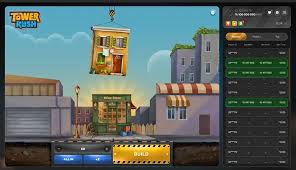
- Set your stake. Enter an amount in the bet field. The ×2 button doubles your previous bet instantly. An All In option stakes your full balance — use it with care.
- Press the yellow Build button to drop the first floor segment onto the tower.
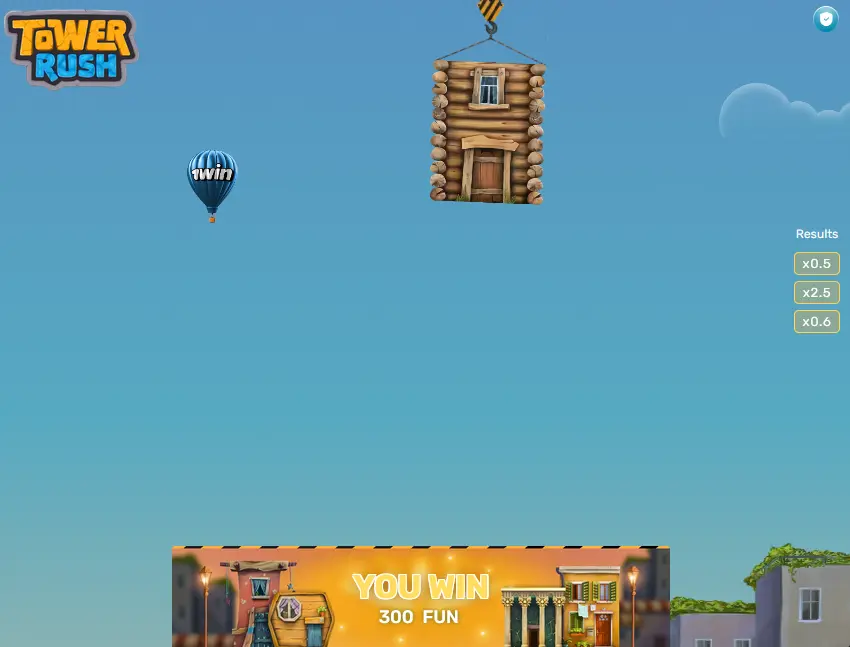
- Watch the placement. A successful landing reveals the multiplier assigned to that floor. Your current potential payout updates in real time.
- Make your decision: press Cash Out to collect your current winnings and end the round, or press Build to drop the next floor and continue climbing.
- If a floor misses the tower, the round ends immediately and the stake is lost — including any multiplier built up on previous floors.
- There is no timer between floor drops. The game does not advance until you press Build, so you can take as long as needed before each decision.
This distinguishes Tower Rush from fully automated crash games where the multiplier moves independently of the player.
The Three Bonus Mechanics
The most significant difference between Tower Rush and other crash-format games is its bonus system. Three distinct features can trigger randomly during any floor drop, and each one changes the dynamic of the round in a different way.
Build 3–5 floors, cash out as soon as the multiplier looks healthy. Lower payouts but steadier returns. Frozen Floor rounds amplify this — secure the lock, then build freely above it.
Push for 8+ floors aiming for 20×–100× range. Most rounds end in collapse, but deep runs with bonus triggers can produce significant payouts. Accepting frequent losses is the price.
Tower Rush vs TOWERS
Both games involve climbing a vertical structure and deciding when to exit. The structural differences between them are meaningful and affect how you actually play.
Who Tower Rush Is For
Tower Rush suits players who want a crash-format game with more mechanical texture than a single climbing multiplier. The bonus mechanics — particularly the Frozen Floor — introduce round states that break the standard binary of cash out or lose everything.
Players who prefer grid-based decision-making and precise probability control per step are better served by TOWERS. Tower Rush does not offer that level of configurability.
The $0.01 minimum bet makes Tower Rush accessible for extended low-stakes play. The 100× cap keeps the game grounded — if you want a title where a single round could multiply your stake by 1,000× or more, this is not it.
There is no autoplay. Every round requires a manual Build press to start, which means the game demands consistent active attention. Players who prefer automated sessions will find this a limitation rather than a feature.
Quick Summary Table
Tower Rush: crash-format, Galaxsys, 95.4% RTP, 100× cap, three bonus mechanics, no risk configuration, arcade pacing. Best for players who want variety and bonus-driven rounds.
TOWERS: grid-format, 1Win Games exclusive, configurable mines, no bonus features, uncapped multiplier potential. Best for players who want precise probability control.
Choose Tower Rush if you prefer dynamic rounds with Frozen Floor insurance, Temple Floor wheels, and Triple Build acceleration.
<strong>Choose TOWERS</strong> if you prefer deliberate cell selection, pre-round risk setting, and the possibility of extreme multipliers beyond 100×.
FAQ
Tower Rush at 1Win — common questions
Tower Rush is a fast game developed by Galaxsys, built around a construction site concept. Floor segments drop onto your tower one at a time, and each successful placement increases your multiplier. You decide when to cash out — or the tower collapses and your stake is lost. It sits in the crash game category by format but differs from standard crash games through its three unique bonus mechanics.
Tower Rush is developed by Galaxsys and is available on 1Win as part of the fast games section. Unlike TOWERS, which is a 1Win Games original exclusive to the platform, Tower Rush is a Galaxsys title and may appear on other platforms as well.
The RTP of Tower Rush is 95.4% with high volatility. This means the game returns 95.4% of total wagered amounts to players over a large number of rounds. High volatility reflects the fact that outcomes can vary significantly depending on how aggressively or conservatively you build.
The minimum bet is $0.01, making the game accessible for extended low-stakes sessions. The maximum bet per round is $100. The maximum payout is $10,000 or 100× your stake, whichever is reached first.
The multiplier cap in Tower Rush is 100× your stake, with a maximum payout of $10,000. While this ceiling may seem conservative compared to crash games advertising unlimited multipliers, it sets a realistic and genuinely attainable target. Most experienced players focus on consistent exits in the 10–20× range rather than pushing for extreme heights.
Set your stake, press the yellow Build button to drop the first floor, and watch it land. A successful placement reveals that floor's multiplier and updates your potential payout in real time. You then choose to Cash Out and collect your winnings or press Build again to continue. If a floor misses the tower, the round ends immediately and your stake is lost. There is no timer — the game only moves when you press Build.
No. Tower Rush has no countdown or time limit between floor drops. The game does not advance until you press Build, which means you can take as long as needed before each decision. This distinguishes it from automated crash games where the multiplier climbs without player input.
Tower Rush has three randomly triggered bonus features that can appear during any floor drop. The Frozen Floor locks your current winnings, guaranteeing them regardless of what happens next. The Temple Floor activates a ten-section prize wheel that awards an additional multiplier on top of your current winnings. The Triple Build delivers three floors simultaneously, each with its own multiplier, accelerating tower height and payout accumulation in a single drop.
The Frozen Floor is a bonus mechanic that triggers randomly during a round. When a floor reveals itself as frozen, your accumulated winnings at that point are locked and secured — even if the tower collapses on a later floor, you keep that amount. You can continue building above the frozen sum with no risk to what is already guaranteed. The Frozen Floor triggers at most once per round and prevents further bonus mechanics from appearing after it activates.
The Temple Floor activates a ten-section prize wheel automatically when it lands. The wheel contains multiplier values of ×1.50, ×2, ×3, ×5, and ×7 across paired sections, plus one Frozen Floor Bonus section. The awarded multiplier applies to your current winnings and stacks with the standard floor multiplier. Unlike the Frozen Floor, the Temple Floor can trigger multiple times within a single round.
Triple Build is a bonus mechanic disguised as a standard floor until it lands. When it triggers, three floors are delivered simultaneously, each carrying its own multiplier of ×1 or higher. All three land as part of a single drop, significantly accelerating both tower height and multiplier accumulation without any additional placement risk. Triple Build can also trigger multiple times per round.
Yes and no. The Temple Floor and Triple Build can each trigger multiple times within a single round. However, once the Frozen Floor activates, no further bonus mechanics can appear in that round. A round can therefore include multiple Temple Floor and Triple Build events, but the Frozen Floor always marks the end of bonus activity for that session.
No. Tower Rush does not have an autoplay feature. Every round requires a manual Build press to begin, and each subsequent floor drop also requires active input. Players who prefer to set parameters and run automated sessions will find this a limitation. The game is designed for consistent active engagement throughout.
Both games involve climbing a vertical structure and cashing out before a collapse, but they are structurally different. TOWERS uses a grid format where you select a cell at each level, with a configurable number of hidden mines setting your risk per step. Tower Rush has no grid and no cell selection — floors drop automatically and your only decision is when to cash out. TOWERS has no bonus mechanics. Tower Rush has three. TOWERS has no stated multiplier cap and can theoretically reach very high values. Tower Rush caps at 100×. TOWERS feels like a deliberate probability exercise; Tower Rush has a more kinetic, arcade-like quality.
It depends on what you want from a session. Tower Rush suits players who want mechanical variety, bonus features, and a more dynamic round-to-round experience. TOWERS suits players who prefer precise risk configuration, grid-based cell selection, and theoretically uncapped multipliers. Neither is objectively better — they serve different preferences within the same broad game category.
Tower Rush works well for players who want a crash-format game with more variety than a standard single-multiplier climb. The bonus mechanics — especially the Frozen Floor — create round states that break the all-or-nothing structure of most crash games, making longer sessions feel less repetitive. Players who prefer configurable risk levels and grid-based decisions are better served by TOWERS. Players who want extremely high multiplier potential beyond 100× should also look elsewhere.